Ahiru no Ko
The Ugly Duckling
Connectez-vous pour utiliser les fonctionnalités ci-dessous
Synopsis
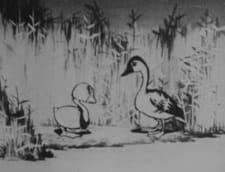
Four ducklings start swimming in the pond just days after hatching. Their mother is still sitting on the last and largest egg. The grandmother duck, who enjoys chatting, worries it might be a turkey egg. The chick that hatches three days later has a long neck and quacks unusually. However, the mother duck is relieved to see the youngest duckling actively training to swim. Due to his appearance, he is mocked by dogs, bullied by frogs, and ostracized by his four brothers. One evening, the youngest duckling leaves his mother and brothers. In autumn, the duckling, who continues to travel alone, asks a goose to join his flock. While they talk, they see a hunter fire a gun and barely escape the hound. Winter arrives, and the duckling is lying on a bed in a cabin near a second house on the lakeside. A black cat and a hen are watching the duckling with concern. The duckling wakes up and is told by the black cat that he was saved from a weasel attack. The hen says the duckling doesn't look like a duck, and the black cat tells him he can stay as long as he wishes. Summer follows spring. Children in a second house spot a beautiful swan. The black cat tells the hen that he is proud of having raised the swan. The young swan's days are peaceful and happy. As evening falls, the swan remembers his gentle mother duck.
Arrière-plan
The 62nd issue of the Athena Film Library series of education movies produced by Yokohama Cinema Shokai. A talkie version labeled "Yoshizaka-style recording" was also released. The original length of the 35-mm version is 323 m per volume for the silent version and 535 m for the two-volume talkie version. In addition to a 35-mm version, a 16-mm Sakura Graph version was also released by Konishiroku Honten. Here is the advertisement of the movie at the time: "Andersen's famous fairy tale has been produced as an excellent animation. This animation, produced by a master, depicts a lovely and idyllic world of ducklings filled with pathos and artistry. It is a work of art that can be created only by a virtuoso" (Eiga Kyoiku, October 1932). According to The History of Japanese Animation (Katsunori Yamaguchi & Yasushi Watanabe, Yubunsha, 1977, p. 206), photos of girls reading Andersen's fairy tales are added before and after the animation in the talkie version. A real-life film of a girl and a boy watching a swan is also inserted in this version. Andersen's original story ends with the joy of the duckling, who, bullied by others, believed himself to be ugly but realizes he is a beautiful swan. In contrast, the ending of the adaptation by Chuzo Aochi is filled with pathos, where the swan remembers his gentle duck mother while quietly swimming in the lake.
Informations
Classification
G - Tous Publics (G)
Type
Movie
Statut
Finished Airing
Source
Book
Statistiques MAL
Connectez-vous pour évaluer cet animé
Se ConnecterCommentaires (0)
Connectez-vous pour commenter.

Aucun commentaire pour le moment.
Soyez le premier à commenter !